
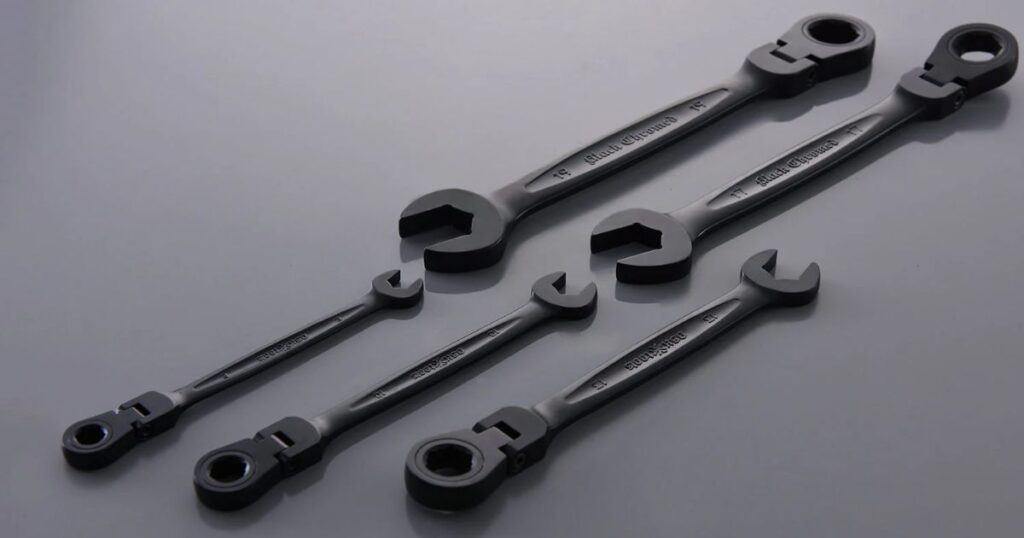
A ratchet wrench head looks simple from the outside, but it carries three concentric features — the 12-point spline, the ratchet seat bore, and the connecting boss — that all have to stay coaxial under repeated impulse loads. Ratchet wrench head machining is the production stage where that coaxiality is either locked in by geometry or lost to accumulated setup errors. This guide walks through why a 4-axis turn-mill machine, run as a done-in-one cell, is the most reliable answer for chrome vanadium (Cr-V) hand tool manufacturing process work.
Why ratchet wrench head machining is precision-critical
The ratchet wrench head is the load-bearing core of every ratchet wrench used in auto repair, industrial assembly, and general maintenance. Its 12-point spline meshes with the drive socket, the ratchet seat houses the pawl mechanism, and the connecting boss carries torque to the handle. All three features must share the same datum; if the spline drifts off the seat axis, pawl engagement turns notchy, the tooth flanks wear unevenly, and the wrench loses the smooth small-angle release that defines a quality hand tool.
Tooth profile, bore roundness, and inter-feature coaxiality therefore drive perceived quality directly — they decide whether a head feels solid in the hand or rough on the first turn. Multi-axis CNC machining with single setup machining is the cleanest way to hold all three at once on production volume.
Why traditional forging plus multi-setup machining falls short
The traditional production route — forge the blank, then move it through a lathe, mill, drill, and tap on separate machines — looks economical per machine-hour but stacks errors at every transfer. Each new chuck, fixture, and zero re-introduces alignment uncertainty that no downstream inspection step can fully recover.
Three numbers from the source production audit capture the cost of that fragmentation:
– *Coaxiality drift ≥0.1 mm between the spline bore and the ratchet seat after multi-setup machining, enough to make pawl engagement feel notchy and to accelerate tooth flank wear in service. – Single-piece cycle of around 25 min across the lathe-mill-drill chain, dominated by inter-machine transfer, re-clamping, and zeroing rather than actual cutting time. – Form tolerance ±0.05 mm on the 12-point spline*, wide enough that hand-feel quality varies noticeably batch to batch even when each individual machine is within its own spec window.
The structural problem is that coaxiality, cycle time, and tooth tolerance are all symptoms of the same root cause: features that need to be coaxial are being cut against different datums. No amount of tighter post-process inspection on a multi-setup line removes that, which is why ratchet wrench head machining at production volume needs a different machine architecture, not a tighter inspection step.
How a 4-axis mill-turn machine handles it in one setup
A 4-axis mill-turn machine — turning spindle (Z), radial feed (X), longitudinal feed (Y), plus a programmable rotary C-axis — holds the part in a single chuck from raw bar to finished head. The C-axis indexes the workpiece so the same turret can turn the OD, mill the 12-point spline, drill the pawl seat, and tap the threads without ever releasing the part. This mill/turn consolidation of operations into one setup is what removes the part-handling steps where error accumulates. Every feature is cut against the same datum, so coaxiality stops being a tolerance to chase and becomes a property the geometry guarantees.
The diagram below contrasts the two routes side by side.
flowchart TB
    A[Cr-V bar stock<br/>15-20 mm dia + 5 mm allowance] --> B{Machining route}
    B -->|Traditional multi-setup| T1[Forge blank]
    T1 --> T2[Lathe: turn OD and seat]
    T2 --> T3[Mill: 12-point spline]
    T3 --> T4[Drill + tap on separate stations]
    T4 --> T5[Coaxiality drift >= 0.1 mm<br/>cycle ~25 min<br/>tooth tolerance +/- 0.05 mm]
    B -->|4-axis mill-turn one-setup| M1[Single chuck: turn OD and seat]
    M1 --> M2[C-axis index: mill 12-point spline]
    M2 --> M3[Same setup: drill pawl seat + tap M5]
    M3 --> M4[Shared datum<br/>locked-in coaxiality<br/>consistent tooth form]
Done-in-one machining collapses the lathe-mill-drill chain into a single program. Inter-machine transfer, re-zero, and re-clamp time disappears, batch-to-batch variation drops because human handling is removed from the middle of the cycle, and the mill-turn machine for ratchet wrench production becomes a self-contained cell rather than the head of a multi-station line.
Tooling and Cr-V steel stock setup
Chrome vanadium steel machining for ratchet wrench heads runs on Cr-V round bar stock in the 15–20 mm diameter range, cut to length per wrench size with about 5 mm of axial machining allowance. Tooling for ratchet wrench head machining lives in the same turret throughout the cycle so the part program — not the operator — switches between operations:
– *Carbide turning tool for the OD and ratchet seat, ground to handle Cr-V’s work-hardening tendency without chatter. – 12-point carbide form cutter dedicated to the spline; the C-axis indexes the part 30° between teeth so each tooth is cut with identical plunge geometry. – Φ6 mm end mill for the ratchet pawl pocket and any intermediate pockets inside the seat. – Φ4 mm twist drill for the cross-hole that pins the pawl spring. – M5 tap* for the retaining-screw threads.
Because every tool addresses the part on the same datum, the spline tooth form, the seat bore, and the threaded hole all reference each other directly. That removes the stack-up error that 4-axis turn-mill machine alternatives running as multi-machine workflows cannot fully avoid, regardless of how well any single station is calibrated.
Machine features that stabilize Cr-V mill-turn cutting
A done-in-one cell only pays off if the machine itself can hold tolerance across a full production shift. Four design choices matter most for Cr-V ratchet wrench head machining at production volume:
– *Symmetric drop spindle box with water cooling. Cr-V removal generates real heat at production feed rates; an actively cooled symmetric housing keeps thermal growth balanced so the spindle axis does not walk during a long batch. – 30° slant X-axis on a slant-bed structure. The slant-bed layout damps heavy-cut vibration and lets chips fall clear of the work zone, which matters when the same setup is alternating between turning and milling cuts on the same part. – Front-mounted hydraulic control panel.
Chuck pressure is the single biggest variable behind dimensional drift on Cr-V; a front-accessible panel lets the operator monitor and trim hydraulic pressure without leaving the station. – SYNTEC 22TB CNC controller.* The controller synchronizes the four axes and handles the C-axis indexing required for the 12-point spline form, while keeping the part program straightforward enough to maintain on-shop.
Together, these features turn done-in-one machining from a theoretical advantage into a repeatable production property batch after batch. They are also why ratchet wrench head machining stays in spec through long shifts on Cr-V, where lesser platforms drift as the machine warms.
FAQ
*Which axes does a 4-axis mill-turn machine actually combine?* The turning spindle (Z), radial feed (X), longitudinal feed (Y), and a programmable rotary C-axis. The C-axis indexes the chuck to any angle, so milling, drilling, and tapping all happen without re-clamping the part.
*Why is chrome vanadium (Cr-V) steel preferred for ratchet wrench heads?* Chromium and vanadium together give Cr-V the hardness-toughness balance and fine grain structure that ratchet teeth need to resist rounding under repeated impulse loads, while keeping the head tough enough to absorb torque without cracking.
*Can the 12-point spline really be cut in the same setup as the turning operations?* Yes. After turning the OD and ratchet seat, the C-axis indexes the part 30° between teeth and a carbide form cutter mills each tooth on the same datum. Drilling and tapping follow without releasing the part, so coaxiality is locked in by geometry rather than relying on inspection to recover it.
Conclusion
For production-volume ratchet wrench head machining, the biggest lever on cycle time and consistency is consolidating turning, spline cutting, drilling, and tapping into a single chuck on a 4-axis mill-turn machine. Cr-V bar stock, a shared turret of carbide tooling, and a stable thermal and vibration platform under a SYNTEC 22TB controller turn the traditional multi-station chain into a single repeatable cell.
If you are scoping a hand tool manufacturing process upgrade for ratchet wrench production and want to compare configurations against your specific tooth count, bar diameter, or batch-size targets, reach out to UBright with your part drawing and production volume. We are happy to walk through the right 4-axis mill-turn setup for your line.
References
- Canadian Metalworking: Capturing the Power of Mill/Turn — Supports the done-in-one mill-turn architecture that consolidates turning, milling, drilling, and tapping into a single setup.
- makeitfrom: SAE-AISI 6150 Chromium-Vanadium Steel — Supports the Cr-V steel material properties and bar-stock context for ratchet wrench head machining.
- GD&T Basics: Concentricity — Supports the shared-datum coaxiality concept central to single-setup feature alignment.
- Sandvik Coromant: Cutting Tool Materials — Supports the carbide tooling selection for machining work-hardening alloy steel.